Solving the Adults Hard Rectangle Maze Puzzle Vol-40: A Deep Dive into Cognitive Challenge and Design
Maze puzzles have captivated the human mind for centuries, but the Adults Hard Rectangle Maze Puzzle Vol-40 represents a modern evolution of this timeless pastime. Unlike simple children's mazes that offer a clear path after a few wrong turns, these puzzles are engineered for the adult brain, demanding sustained concentration, spatial reasoning, and strategic foresight. At its core, this volume delivers exactly what the title promises: a collection of one hundred distinct rectangles, each containing a complex network of paths designed to test your mental endurance and problem-solving agility.
The Structural Anatomy of a Hard Maze
What distinguishes a genuinely difficult maze from one that merely looks complicated? The Adults Hard Rectangle Maze Puzzle Vol-40 employs several architectural features that elevate the challenge beyond simple distraction. The most immediate characteristic is the presence of multiple branches and loops. A branch presents a binary choice—left or right, up or down—but when these branches cascade into one another, the decision tree grows exponentially. Loops are even more deceptive; they allow the solver to travel in a circle, creating the illusion of progress while actually returning to a previously visited junction. This design forces the solver to maintain a mental map of explored territory, a task that becomes increasingly demanding as the maze deepens.
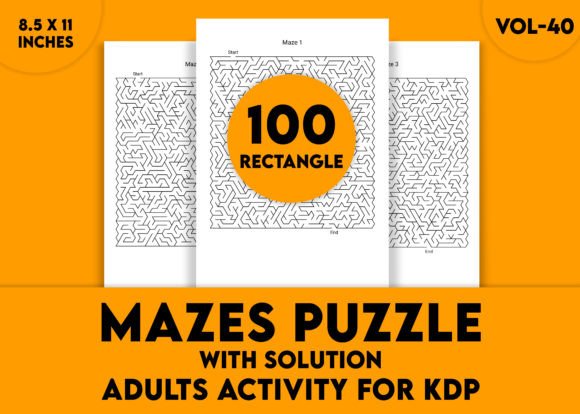
Beyond branching and looping, the puzzles incorporate various types of twists and turns. Some turns are sharp ninety-degree angles, while others may be gradual curves or staggered corridors that obscure the line of sight. The physical layout on the 8.5x11 inch page ensures that each maze occupies a full sheet, giving the designer room to pack in density without sacrificing legibility. The black-and-white line work is crisp, and the paths are wide enough to allow for precise pencil tracing without becoming cramped. This careful balance between complexity and usability is crucial for maintaining the solver's engagement without inducing frustration.
Additionally, many mazes in Volume 40 include obstacles or barriers—elements that block certain routes entirely. These barriers are not merely dead ends; they are often placed at strategic points to mislead the solver into committing to a long branch that eventually terminates. Learning to recognize patterns in barrier placement becomes a skill in itself, one that rewards patience and careful observation over impulsive movement.
Physical Format and Practical Considerations
The decision to print one maze per page on standard letter-sized paper (8.5x11 inches) carries several advantages. For the user, this format provides ample space for note-taking, marking explored paths with arrows or dots, and even sketching a small map of the maze's topology in the margins. The large size also reduces eye strain, allowing for extended solving sessions without fatigue. For educators or facilitators who incorporate puzzles into workshops or cognitive training sessions, the single-page layout simplifies distribution and collection.
Perhaps one of the most useful features of this volume is the inclusion of four solutions per page at the back of the book. Unlike some puzzle collections that relegate solutions to a small, cramped appendix, the 4-solution-per-page layout here strikes a balance between compactness and readability. Each solution shows the complete correct path, overlaid on a miniature version of the maze. This layout is particularly helpful for learners: after struggling with a maze, reviewing the solution allows you to trace the optimal route and compare it with your own attempt. The solutions also serve as a quality control mechanism, confirming that every maze has a single valid solution and is free from design errors.
The editable PDF format is another standout characteristic. In a digital-first world, having a PDF that can be opened, annotated, and even modified on a tablet or computer is invaluable. Users can solve the mazes using a stylus on an iPad or Android tablet, duplicate pages for repeated attempts, or adjust the brightness and contrast for accessibility. This flexibility extends the product's lifespan; one purchase can serve a single user across multiple devices or a group of users through print-sharing.
Real-World Applications Across Audiences
For professionals who spend their days solving complex problems—software engineers, data analysts, urban planners, and architects—the Adults Hard Rectangle Maze Puzzle Vol-40 offers a form of deliberate practice that mirrors the cognitive demands of their work. The process of evaluating a branching path, backtracking to a decision point, and selecting an alternative route is identical in structure to debugging code, optimizing a logistics network, or weighing design tradeoffs. By engaging with these mazes regularly, professionals can sharpen the same mental muscles they rely on during high-stakes decision-making.
Hobbyists and puzzle enthusiasts will find the volume a satisfying challenge that fills the gap between casual puzzles and extreme difficulty. The 100-maze count ensures that even dedicated solvers will have weeks or months of content. The variety within the collection—different maze shapes, obstacle configurations, and path densities—prevents monotony and encourages the solver to adapt their strategies continually. Some mazes may reward a depth-first approach, while others demand a breadth-first exploration. Recognizing when to switch strategies is a meta-skill that only emerges after solving dozens of puzzles.
Researchers and educators in cognitive science can use this volume as a standardized tool for studying spatial navigation, working memory, and planning ability. The uniform format and controlled difficulty make it easy to administer in repeated-measures studies. A researcher might ask participants to solve a maze while under time pressure, or while performing a secondary task, to measure cognitive load. The editable PDF format simplifies the creation of digital versions for online studies, and the solution sheets ensure objective scoring.
Business owners and team leaders can integrate maze-solving into team-building or brainstorming sessions. A group of colleagues working on a hard maze together must communicate, allocate subtasks, and share a mental model of the puzzle's layout. These collaborative dynamics mirror those of effective project teams and can serve as a low-stakes exercise in improving team coordination.
Cognitive Benefits and the Science of Puzzle Solving
Solving a hard rectangle maze is not merely a leisure activity; it is a form of cognitive training with measurable benefits. Research in cognitive psychology has shown that spatial reasoning tasks, including maze navigation, activate the hippocampus and the prefrontal cortex—regions associated with memory, planning, and executive function. When you encounter a loop in the Adults Hard Rectangle Maze Puzzle Vol-40 and must decide whether to follow it or turn back, your brain is engaging in a real-time cost-benefit analysis: explore the loop for potential shortcuts, or conserve time and assume it is a dead end.
Regular engagement with challenging mazes can improve working memory, as the solver must hold the layout of explored and unexplored paths in mind. It also enhances attentional control, forcing the brain to filter out irrelevant branches and focus on promising routes. For adults who spend much of their day multitasking or consuming passive media, the focused, single-task nature of maze-solving provides a welcome and beneficial contrast.
There is also an emotional component. The satisfaction of emerging from a difficult maze—especially one that required multiple attempts—triggers a release of dopamine, reinforcing persistence and effort. This reward mechanism can help build resilience and a growth mindset, particularly for those who approach puzzles with the attitude that mistakes are learning opportunities rather than failures.
Design Trends and the Evolution of Paper Puzzles
The Adults Hard Rectangle Maze Puzzle Vol-40 fits into a broader resurgence of interest in analog puzzles and hands-on problem-solving. In an age of digital saturation, many adults are rediscovering the tactile pleasure of paper, pencil, and eraser. The physical act of tracing a path with a writing instrument, feeling the resistance of the paper, and occasionally erasing a wrong turn is a grounding experience. It requires no batteries, no notifications, and no internet connection—just a quiet space and a few minutes of uninterrupted focus.
Moreover, the rectangle format is a deliberate design choice. Circular or irregular mazes can be visually striking, but they often introduce geometric complexity that distracts from the puzzle itself. The rectangle provides a stable, predictable boundary, ensuring that the solver's attention stays on the internal path structure. The straight edges also make it easier to compare relative positions of features, aiding in mental mapping.
Volume 40's inclusion of multiple difficulty levels within the collection—some mazes being more straightforward while others are highly convoluted—reflects an understanding of user progression. A solver might start with the simpler puzzles to build confidence and learn the designer's conventions, then gradually tackle the harder ones. This laddering effect is pedagogically sound and contributes to the volume's longevity.
Practical Strategies for Maximizing the Experience
To get the most out of the Adults Hard Rectangle Maze Puzzle Vol-40, consider adopting a structured approach. Begin by scanning the entire maze before making any marks. Identify potential bottlenecks, areas where many paths converge, and any obvious barriers. Use a light pencil to mark dead ends as you discover them, and consider adopting a consistent notation—a small X for blocked routes, a dot for decision points. This external memory system reduces cognitive load and prevents repeated exploration of the same dead ends.
For solvers using the editable PDF version, consider duplicating each maze page before solving. This allows you to attempt the same maze multiple times without erasing, and you can compare your different approaches side by side. Over time, you will notice patterns in the mazes, such as the designer's tendency to place barriers near the perimeter or to create long parallel corridors that only connect at the far end. Recognizing these patterns is the hallmark of an experienced solver.
Collaborative solving is another rewarding method. Print a maze for each member of a small group and ask everyone to solve it independently. Compare solution times and paths. Often, there is more than one correct route, and discussing why different solvers chose different paths can reveal interesting insights into individual problem-solving styles. This exercise is especially useful in educational or team-building contexts.
Finally, do not be afraid to set a maze aside and return to it later. The subconscious mind continues to process complex problems even when you are not actively working on them. A fresh perspective after a break can reveal a solution that was invisible during a frustrating session. This incubation effect is well-documented in creativity research and applies directly to maze-solving.
The Broader Context of Puzzle Collections
Volume 40 represents a continuation of a series, and its numbering suggests a dedicated following. For collectors or completionists, there is a satisfaction in working through a numbered series and observing how the puzzle design evolves across volumes. The 100-maze count is substantial enough to represent a meaningful time investment, yet manageable enough to complete with consistent effort. Each maze completed marks a small victory, and the cumulative effect of finishing all one hundred can be surprisingly empowering.
From a design perspective, the rectangle maze is a classic format that has been explored by puzzle creators for decades, yet Volume 40 finds ways to innovate within those constraints. The obstacles and barrier types, the specific branching patterns, and the density of path options all contribute to a fresh experience even for veteran solvers. The volume does not rely on gimmicks or novelty shapes; it earns its difficulty through careful layout and rigorous testing.
For those who enjoy tracking their performance, the solution sheets make it easy to verify accuracy and time yourself. Over the course of the volume, you may notice your solving speed improving, or you may develop new strategies that reduce backtracking. These metrics of progress are intrinsically motivating and can turn a casual hobby into a deliberate practice regimen.
Adaptability for Diverse Environments
The 8.5x11 inch paper format is deliberately standardized, but the ways users can interact with it are diverse. In a quiet home office, the printed maze can be a meditative break from screens. In a busy waiting room, a single sheet slipped into a clipboard provides a portable and engrossing distraction. For travelers, a stack of printed mazes takes up negligible space but offers hours of engagement. The editable PDF extends these benefits into the digital realm, allowing saves, bookmarks, and cloud synchronization across devices.
Educators who teach courses in critical thinking, decision science, or cognitive psychology can assign specific mazes from the volume as homework or in-class exercises. The four-solution-per-page format enables swift grading or self-assessment, and the varying difficulty allows instructors to calibrate assignments to student skill levels. Because each maze is self-contained, there is no need for students to purchase an entire book; instructors can selectively distribute individual mazes as handouts.
For therapists and counselors, maze-solving can be incorporated into sessions focused on executive function training, stress reduction, or mindfulness. The act of tracing a path requires a calm, focused state, and the non-verbal nature of the activity can be especially helpful for clients who struggle with verbal expression. The sense of accomplishment from solving a hard maze can also bolster self-esteem and provide a concrete metaphor for overcoming obstacles.
Ultimately, the Adults Hard Rectangle Maze Puzzle Vol-40 succeeds because it respects the solver's intelligence and offers a genuine challenge. It does not pretend to be something it is not: it is a book of hard mazes, designed for adults, meant to be solved. The features—100 puzzles, single-page layout, solutions, editability, large format—all serve the primary goal of delivering a rigorous and satisfying puzzle experience. Whether you are a seasoned puzzle enthusiast or a curious newcomer looking for a mental workout, this volume provides exactly the kind of thoughtful, demanding content that makes the effort worthwhile.