Adults Hard Hexagon Mazes Puzzles Vol-74: A Deep Dive into Complex Navigation and Cognitive Workout
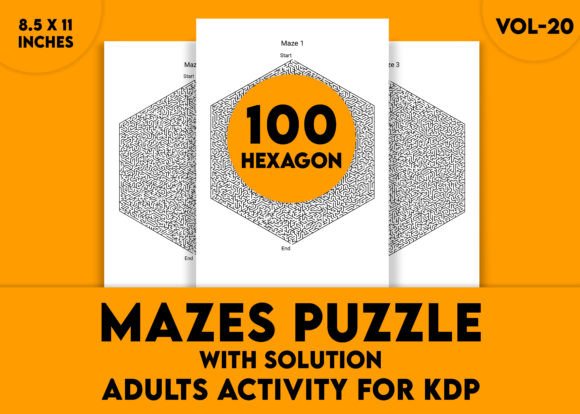
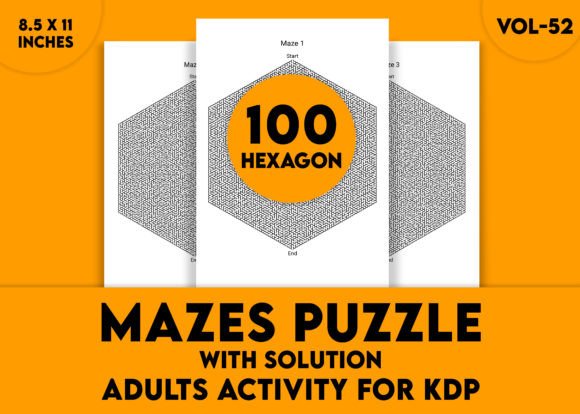
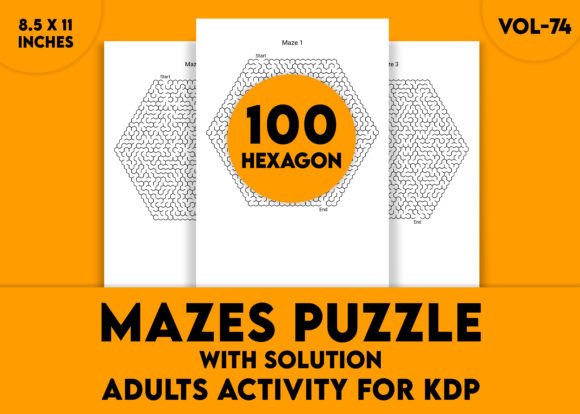
For anyone who has spent time with traditional square or circular mazes, the hexagonal maze represents a distinct departure—a structural shift that immediately alters how you plan a path, anticipate dead ends, and recover from wrong turns. The geometry of the hexagon introduces a six-directional movement system, meaning that at every junction you face more possibilities than in a standard four-directional grid. This is not a minor tweak; it fundamentally changes the strategy required to solve each puzzle. The Adults Hard Hexagon Mazes Puzzles Vol-74 builds its entire experience around this geometric principle, offering 100 separate mazes that are purposely designed to challenge adult problem-solvers who have moved past beginner or intermediate content.
What makes these mazes particularly demanding is not just the hexagon shape, but the way the puzzles are constructed. The mazes incorporate multiple branches that lead nowhere, loops that force you to retrace your steps, and barriers that block obvious routes. You cannot rely on the simple wall-following method that works for many traditional mazes because the branching structure of a hexagon layout creates overlapping pathways that confuse spatial memory. Each maze requires active decision-making, and the difficulty curve is steep enough that even experienced puzzle solvers will find themselves pausing to rethink their approach.
Why Hexagon Geometry Demands a Different Solving Strategy
Most people approach a maze with an ingrained habit of looking for the right-hand wall or the left-hand wall and following it until they reach the exit. This technique works reliably in mazes where every passageway connects in a continuous perimeter. In a hexagonal maze, the wall-following method breaks down because the angles are not orthogonal. A hexagon has 120-degree internal angles, which means that walls meet in ways that create hidden corridors and unexpected turns. The Adults Hard Hexagon Mazes Puzzles Vol-74 exploits this geometric complexity by designing puzzles where a seemingly straightforward path folds back on itself or leads into a dead end that is invisible until you are already committed.
Another critical factor is that hexagon grids tile in a way that creates natural honeycomb patterns. This tiling produces a dense network of adjacent cells, each sharing edges with up to six neighbors. In a typical maze, this density translates into a high number of decision points within a small area. You are forced to evaluate more options per centimeter of progress than you would in a rectangular grid. The cognitive load increases significantly, and the solver must shift from a reactive strategy—just follow the wall—to a proactive strategy that involves scanning ahead and mentally mapping potential routes. This is precisely the kind of mental exercise that makes these puzzles valuable for adults who want to maintain or improve their cognitive agility.
Furthermore, the hexagonal layout changes how you perceive distance and direction. In a square maze, you intuitively understand that moving north means a straight line upward. In a hexagon maze, the axes are diagonal, so what appears to be a forward move might actually be a diagonal shift that changes your position relative to the overall grid. This disorientation is intentional. It forces you to rely less on instinct and more on deliberate spatial reasoning. The Adults Hard Hexagon Mazes Puzzles Vol-74 uses this disorientation as a feature, not a bug, creating puzzles that train you to think in non-linear ways.
Professionals Seeking Focus and Problem-Solving Flow
Many professionals—engineers, architects, software developers, and data analysts—spend their days solving complex problems that require sustained attention and iterative logic. The Adults Hard Hexagon Mazes Puzzles Vol-74 serves as a warm-up or cooldown activity that mimics the cognitive demands of their work but in a lower-stakes environment. For example, a software developer debugging a tangled codebase might find that spending fifteen minutes on a hexagon maze shifts their brain into a pattern-recognition mode that carries over into their work. The maze requires them to track multiple variables simultaneously: where they have been, where they are going, which branches are dead ends, and which loops can be exploited. This mirrors the mental state of debugging or system design. Additionally, the large 8.5x11 inch page size means that the maze is printed with enough room to trace paths with a pen or pencil without feeling cramped, which is essential for professionals who prefer to work with physical media rather than screens.
Educators and Researchers in Cognitive Science
The structural properties of hexagon mazes make them useful as research tools or classroom exercises. Educators teaching spatial reasoning, geometry, or problem-solving methodologies can use the Adults Hard Hexagon Mazes Puzzles Vol-74 as a concrete example of how non-Euclidean thinking works in practice. The fact that each maze is printed one per page means that students can work individually without distraction, and the four solutions per page layout at the back of the volume allows for self-checking or peer review. Researchers studying cognitive decline, attention span, or executive function may find these mazes useful as standardized tasks that involve planning, working memory, and error correction. The hexagonal design offers a novel stimulus that is not contaminated by prior experience—most adults have solved square mazes before, but few have extensive experience with hexagon mazes, so the learning curve is more controlled.
Hobbyists and Enthusiasts of Complex Puzzles
For the dedicated puzzle hobbyist, simply finding a set of mazes that is genuinely difficult can be frustrating. Many commercial maze books are labeled as "hard" but turn out to be solvable in under a minute. The Adults Hard Hexagon Mazes Puzzles Vol-74 positions itself differently. The 100 mazes are designed with the expectation that each one will require between several minutes to potentially an hour of focused work. Hobbyists will appreciate the variety of twist types—some mazes feature long corridors with sudden barriers, others are dense with loops that require backtracking, and still others use obstacles that force the solver to go around rather than through. The editable PDF format is a practical advantage here: hobbyists can load the file onto a tablet, draw paths digitally, or print multiple copies of the same maze to attempt different solving strategies. This flexibility makes the volume suitable for both analog and digital workflows.
How the Physical Format Enhances the Solving Experience
The decision to print each maze on a separate 8.5x11 inch page is not arbitrary. At this size, a hexagonal maze has room to spread out without becoming microscopically small. The cells are large enough to see clearly, the walls are thick enough to distinguish from pathways, and there is ample white space around the perimeter for notes or doodling. This matters because a difficult maze often requires you to mark dead ends, highlight confirmed paths, or jot down observations about the structure. When a maze is crammed onto a page with multiple puzzles, these practices become messy or impossible. The single-page-per-maze layout respects the solver's need for clarity and organization.
Moreover, the 8.5x11 inch paper size is a universal standard in the United States, meaning that users can easily store the pages in binders, folders, or portfolios. This is practical for collectors who want to archive their completed puzzles or for educators who need to distribute individual pages to a class. The Adults Hard Hexagon Mazes Puzzles Vol-74 also includes four solutions per page at the end of the volume, which is a thoughtful design choice. Instead of flipping back and forth between a solution key and the puzzle page—which breaks concentration—you can view multiple solutions at once, compare different solving approaches, or check your work without disrupting your flow. The solutions are presented in a compact format that does not give away the answer accidentally, so you can use them as hints rather than spoilers.
Understanding the Role of Twists, Turns, Branches, and Loops
One of the distinguishing features of this volume is its deliberate use of complex topological elements. A twist in a maze refers to a section where the path curves back on itself in a way that is not immediately obvious. In hexagon mazes, twists often occur at the junctions where three hexagons meet, creating a kind of optical illusion that makes the correct path appear to be blocked when it is not. A turn is simply a change in direction, but in a hexagonal grid, turns happen at 60-degree or 120-degree increments, which means you can rotate your direction of travel without ever making a 90-degree turn. This unfamiliar rotation adds to the cognitive load because your internal compass struggles to keep track of orientation.
Branches are the points where the path splits into two or more directions. In a typical square maze, a branch might offer three options: left, straight, or right. In a hexagon maze, a branch can offer up to six options, though five or six is rare in practice. Most branches in the Adults Hard Hexagon Mazes Puzzles Vol-74 offer three or four choices, but the geometry makes it harder to remember which option you have already tried. This is where loops become critical. A loop is a section of the maze that connects back to a previous point, allowing you to revisit an area from a different direction. Loops can be helpful—they provide alternative routes—but they also create confusion because you may accidentally traverse the same loop multiple times without realizing it. The best strategy is to mentally mark loops as explored once you have identified them, then focus your attention on branches that lead away from the loop.
Obstacles or barriers appear in some of the mazes as solid blocks that completely seal off certain pathways. Unlike walls, which are part of the maze's permanent structure, obstacles are placed strategically to force you to take a longer route. In a hexagon maze, an obstacle can be particularly frustrating because it might block the only apparent path out of a region, requiring you to backtrack through several branches. The presence of obstacles raises the difficulty level significantly, and the Adults Hard Hexagon Mazes Puzzles Vol-74 seems to place these barriers in positions that test your ability to think ahead. Anticipating where an obstacle might be hidden based on the pattern of walls is a skill that develops with practice, and the volume's 100 puzzles provide ample opportunity for that skill to mature.
Practical Workflow for Solving with the Editable PDF Feature
One of the often-underappreciated advantages of a PDF-based puzzle collection is the ability to iterate without wasting paper. The Adults Hard Hexagon Mazes Puzzles Vol-74 is delivered as an editable PDF file, which means you can open it on a tablet or computer and use drawing tools to trace your path. If you make a mistake or want to try a different route, you can simply undo or erase without leaving marks on the paper. This is ideal for adults who want to preserve the pristine condition of the puzzles for future attempts or for sharing with others. Additionally, the editable PDF format allows you to adjust the view—zooming in on complex sections or zooming out to see the full structure—which is something you cannot do with a printed page. If you prefer handwriting, you can print the PDF on your own paper at 8.5x11 inches, and because there is one maze per page, you can print only the mazes you want to solve, saving ink and paper.
A practical workflow for using this volume might look like this: start by printing a single maze or opening it on a tablet. Study the entrance and exit positions—usually located at opposite edges or at the center and edge—to get a sense of the overall shape. Then, instead of diving in immediately, spend thirty seconds scanning the maze for obvious dead ends and long corridors. This initial reconnaissance phase is crucial for hexagon mazes because the geometry can hide patterns that are visible only from a distance. Once you begin, use a pencil (or digital pen) to trace your path lightly, and when you hit a dead end, mark it clearly with an X or a dot so you do not revisit it. If you encounter a loop, try to map its boundaries so you know when you are leaving the loop and entering new territory. After solving, compare your route to the solution page (if needed) to see if there was a more efficient path. Over the course of 100 mazes, this workflow becomes second nature, and your solving speed and accuracy will improve.
Cognitive Benefits That Extend Beyond the Puzzle Itself
Engaging with hard hexagon mazes is not just a pastime; it is a form of cognitive exercise with documented benefits. Solving a complex maze activates the prefrontal cortex, the part of the brain responsible for planning, decision-making, and impulse control. When you encounter a branch in the Adults Hard Hexagon Mazes Puzzles Vol-74, you have to decide which direction to explore first, and that decision involves evaluating probabilities based on limited information. Over time, this practice strengthens your ability to make decisions under uncertainty, a skill that translates directly to real-world scenarios like project planning, navigation, and even social problem-solving. The loops in the mazes teach persistence and systematic thinking—you learn that a dead end is not a failure but a piece of data that eliminates one option and clarifies the remaining possibilities. This mindset shift is valuable for anyone who works in an environment where trial and error is part of the process.
Additionally, the visual-spatial aspect of hexagon mazes improves your ability to mentally rotate objects and visualize pathways. This is a type of spatial intelligence that is used in fields ranging from surgery to graphic design to architecture. An architect, for example, might find that solving these mazes enhances their ability to visualize how a floor plan connects different rooms, while a graphic designer might benefit from the pattern recognition skills needed to spot visual inconsistencies. Even for someone who does not work in a spatial field, the act of repeatedly solving hexagon mazes can slow age-related cognitive decline by keeping the brain engaged with novel, complex tasks. The fact that the mazes are specifically designed for adults means that the difficulty level is appropriate for mature cognition—not too easy to be boring, and not so hard that it becomes frustrating.
Considerations for Getting the Most Out of This Volume
Given that the Adults Hard Hexagon Mazes Puzzles Vol-74 contains 100 mazes, it is worth thinking about how to pace yourself. Some solvers prefer to tackle one maze per day as a mental warm-up, while others may set aside an afternoon to solve several in a row. Both approaches work, but it is important to recognize that solving multiple hexagon mazes in a single session can lead to mental fatigue because each maze requires sustained concentration. A good strategy is to stop when you notice your error rate increasing—when you start taking wrong turns more frequently or feel impatient with the backtracking. This is a sign that your cognitive resources are depleted, and continuing will only reinforce sloppy habits. Taking a break and coming back later with fresh eyes often leads to a faster solution.
Another consideration is the use of the solution pages. While it is tempting to peek when you feel stuck, doing so too early can rob you of the learning opportunity. The Adults Hard Hexagon Mazes Puzzles Vol-74 includes four solutions per page, which means you can glance at a solution to see if you are on the right track without seeing the entire path. For example, you might look at the solution just long enough to confirm that a particular branch is correct, then continue solving with that confirmation. This selective use of the solution key turns it into a hint system rather than an answer key. For educators or puzzle group facilitators, the editable PDF format also allows you to remove the solution pages before distributing the puzzles, then provide them later for self-assessment.
Finally, the large 8.5x11 inch page size means that these mazes are suitable for group solving activities. You can project a maze onto a screen and solve it collectively, or print multiple copies for a team-based competition. The hexagon design ensures that even if participants have seen traditional mazes before, they will be encountering something new, which levels the playing field for teams with mixed experience levels. Whether you are using the volume for solitary brain training, classroom instruction, research experiments, or recreational puzzling, the combination of geometric complexity, large format, and digital flexibility makes this a robust resource for anyone serious about maze solving as a cognitive practice. The 100 puzzles provide enough variety to keep the experience fresh, while the consistent difficulty ensures that you are always being pushed to think more carefully about each path you choose.