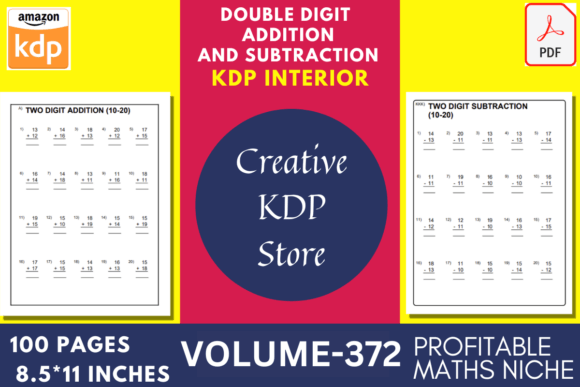
How to Use Addition and Subtraction Volume-380 for Effective Math Practice and Publishing
If you are looking for a straightforward, ready-to-use math practice resource, Addition and Subtraction Volume-380 offers exactly that. It is a 100-page, 8.5 x 11-inch print-ready PDF that contains 50 pages of addition problems (numbers 10 to 99) and 50 pages of subtraction problems (same range), each with a full answer key. The file is designed with no bleed and high resolution, making it suitable for both digital distribution and physical printing. Whether you are a teacher preparing daily drills, a homeschool parent building independent practice, or a self-publisher assembling a math workbook on Amazon KDP, this interior can save hours of formatting and content creation.
Where Addition and Subtraction Volume-380 Fits in a Broader Workflow
Creating math practice materials from scratch requires understanding scope, difficulty progression, formatting constraints, and answer key accuracy. This volume eliminates the heavy lifting by providing a structured set of problems that cover two-digit addition and subtraction. It fits into several common workflows:
- Classroom or tutoring sessions: Use the pages as warm-ups, timed tests, or homework assignments. The clear layout and consistent problem size help students focus on computation rather than deciphering instructions.
- Homeschool lesson planning: Parents can pull a page each day to reinforce skills. The inclusion of answers allows for quick grading or self-checking by older students.
- KDP publishing: Self-publishers can use this interior as a standalone workbook or combine it with other volumes (e.g., multiplication, fractions) to create a series. The no-bleed specification ensures compatibility with KDP’s standard trim sizes and eliminates extra prep work.
The volume is best used after a student has learned the basic concept of regrouping (carrying and borrowing) but needs consistent practice to build speed and accuracy. For teachers, it works well during a unit on two-digit operations. For publishers, it can be the core content of a product launched after market research identifies demand for math workbooks in the elementary age range.
Practical Integration with Other Tools and Resources
Addition and Subtraction Volume-380 does not exist in isolation. It interacts with several common tools and methods that you likely already use:
Printing and Binding
Because the file is set to 8.5 x 11 inches with no bleed, it prints cleanly on standard letter-size paper. You can use a home printer, a print shop, or KDP’s print-on-demand service. For a classroom set, consider spiral binding or three-hole punching to place in a binder. The answer key pages can be printed separately or kept in a teacher’s manual.
Digital Use
You can also use the PDF digitally on a tablet or computer. Students can write answers using annotation tools (like GoodNotes or Notability). This approach saves paper and allows for easy reusability. The high-resolution text remains sharp even when zoomed in.
Combining with Other Volumes
If you are building a comprehensive math workbook, you can merge Addition and Subtraction Volume-380 with other volumes covering multiplication, division, or mixed operations. Because the interior is already formatted with consistent margins and font sizes, combining PDFs using a tool like Adobe Acrobat or a simple PDF merger works seamlessly. Just ensure you maintain the same trim size and no-bleed setting across all files.
Answer Key Management
The answers are included within the same PDF. For teachers, this means you can photocopy only the problem pages for students and keep the answer key pages separate. For self-publishers, you have a choice: include the answer key at the back of the book or omit it depending on your target audience. Some buyers prefer answer keys for self-study; others want them omitted to challenge students. Having them integrated gives you flexibility to edit the PDF before upload.
Preparation and Usability Considerations
Before you start using Addition and Subtraction Volume-380, there are a few practical factors to address:
File Structure and Resolution
The PDF comes with high resolution, meaning it prints clearly even at 300 DPI. The document sources are provided, which can be useful if you need to modify the layout (e.g., add your own cover page, adjust spacing, or change font). Check that your PDF viewer or editor handles the file without compression artifacts. For KDP upload, the resolution meets Amazon’s requirements as long as you do not further compress the file.
No Bleed – What It Means
No bleed means the content does not extend to the edge of the page. This is important for print-on-demand services because it avoids content being cut off during trimming. The interior margins are already set appropriately for a standard 0.5-inch margin. When you add a cover (which usually requires bleed), you will need a separate file for the cover. The interior itself is ready to use without extra adjustments.
Compatibility with KDP Specifications
If you plan to publish on KDP, verify that the PDF matches the required resolution (300 DPI), color space (RGB or CMYK as per your preference), and page count (100 pages). The no-bleed interior is perfectly suited for KDP’s standard black and white interiors. You can upload it directly after adding a cover. Some publishers prefer to add a title page or copyright page before the content. Since the PDF is modular, you can insert a few pages at the beginning using any PDF editor.
Implementation Tips for Different Users
Depending on your role, you can integrate Addition and Subtraction Volume-380 into your routine with minimal friction.
For Educators and Tutors
Print a stack of pages and organize them by difficulty. Although the volume covers 10-99 for both addition and subtraction, you can select specific pages that focus on smaller numbers first (e.g., pages with sums under 50) and gradually move to larger numbers. Use a few pages as diagnostic assessments at the start of a unit. Then reuse the same pages later to measure progress. The answer key allows for quick grading sessions or peer-checking activities.
For Homeschooling Parents
Create a daily math warm-up routine. Give your child one addition page and one subtraction page per day. Set a timer (5–10 minutes) and then review answers together. Because the problems are repetitive but not identical, children build computational fluency without getting bored. If your child finishes quickly, you can fold the page so only half the problems are visible, extending the resource.
For Self-Publishers and Content Creators
When listing your workbook on KDP, use the product description to highlight the specific features: 100 pages, answers included, no bleed, and the exact number range (10-99). This helps buyers looking for a targeted practice book. You can also use the interior as a freebie lead magnet on your website to build an email list. Because it is ready to print, you can deliver it immediately after sign-up. Another approach is to bundle several volumes together into a “Math Practice Bundle” with a discounted price.
For Entrepreneurs Building a Brand
If you are creating a series of educational workbooks, consistency in interior design builds brand recognition. Addition and Subtraction Volume-380 uses a clean, minimal layout. You can create a similar style for other volumes (multiplication, division, fractions) by following the same font choices and margin settings. Over time, customers will associate your brand with reliable, no-fuss practice materials.
Quality Control and Long-Term Use
Because the volume is pre-formatted, the main quality control concerns revolve around how you use the PDF rather than the content itself. Here are observations to help you maintain quality over the long run:
- Refresh your file: After many prints, the digital file may accumulate distortion if repeatedly saved and exported. Keep the original PDF in a safe location and always start from that master when generating new copies.
- Check printing alignment: When printing at home, test one page first to ensure margins are correct and no content is clipped. Adjust printer settings for “actual size” rather than “fit to page” to preserve the layout.
- Update for multiple editions: If you decide to create a second edition (e.g., Volume-381), you can use the same format but change the numbers or operation types. The source documents allow for easy editing if you have the right software.
- Monitor user feedback: If you sell the workbook, pay attention to reviews regarding answer accuracy, page count, and difficulty level. This volume has been designed with correct answers, but double-checking a few pages before publication adds confidence.
Useful Observations on Workflow Efficiency
When you first open Addition and Subtraction Volume-380, you might notice that the problem density is consistent across all pages. This is intentional: it ensures that each page takes roughly the same amount of time to complete, making it easier to plan timed activities. For a publisher, this uniformity means you can set a standard price per page without worrying about variable value. For a teacher, you can assign the same number of problems to all students without one page being noticeably longer.
Another observation is the choice of numbers 10-99. This range avoids single-digit problems (which are too basic) and three-digit numbers (which introduce complexity like thousands place). It hits the sweet spot for second and third graders who are mastering the standard algorithm. By focusing exclusively on this range, the volume allows for deep practice rather than shallow coverage of many ranges.
The answer key is provided in the same PDF but on separate pages. This makes it easy to remove the answer pages before distributing to students. Some publishers prefer to put the answer key at the very end so that it is easy to cut off. Check the page ordering in your PDF viewer; if the answers are interspersed, you may need to rearrange them. Typically, the addition and subtraction answer keys are grouped at the back, which is a practical choice.
Integrating into a Larger Learning System
Addition and Subtraction Volume-380 is most effective when used as part of a structured math curriculum, not as a standalone teaching method. Think of it as a tool for the “practice” phase after instruction. Here is how it fits into a typical learning cycle:
- Concept introduction: Use manipulatives (base ten blocks, number lines) to explain regrouping.
- Guided practice: Work through a few examples together using a whiteboard.
- Independent practice: Assign one or two pages from Volume-380.
- Review and correct: Use the answer key to go over mistakes and discuss strategies.
- Reinforcement: Repeat with different pages until fluency is achieved.
This cycle can be applied in classrooms, homeschool settings, or tutoring sessions. For self-publishers, you can create a companion guide that suggests a schedule (e.g., “Page 1 to 5 for Week 1”). This adds value to your product without requiring additional content creation.
Final Thoughts on Practical Implementation
Addition and Subtraction Volume-380 is a straightforward resource that avoids unnecessary frills. Its value lies in its readiness and focus. Whether you print it for immediate use or upload it to a publishing platform, the key to getting the most out of it is planning how it fits into your existing workflow. If you are an educator, integrate it into your weekly lesson plans. If you are a content creator, use it as a building block for a larger product line. By understanding the file specifications and tailoring its use to your audience, you can save time and deliver consistent math practice that actually improves computational skills.