The Learning to Tracing Activity Book: A Comprehensive Tool for Early Childhood Skill Development
In the landscape of early childhood education, few activities blend cognitive development, fine motor skill practice, and creative engagement as effectively as tracing. A well-designed tracing activity book serves as a bridge between playful exploration and structured learning. Among the many resources available, the Learning to Tracing Activity Book KDP stands out as a versatile, ready-to-publish tool that caters to both educators and parents seeking a systematic approach to pre-writing skills. This article explores the anatomy of such a book, its core components, practical applications, and the underlying considerations for creating or using a tracing workbook in today’s digital and print publishing environment.
Understanding the Structure of a Tracing Activity Book
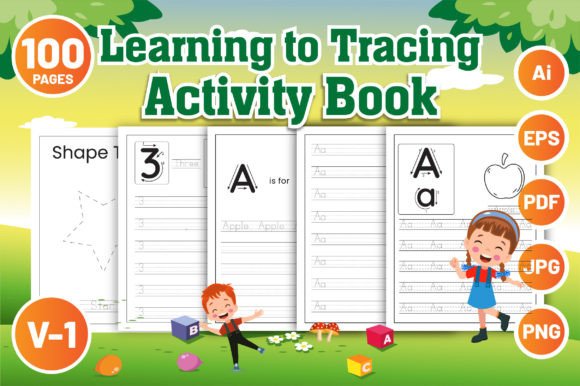
At first glance, a tracing book may appear straightforward: a collection of lines and shapes for a child to follow. However, a well-constructed activity book, such as the Learning to Tracing Activity Book for Kids, is meticulously organized to scaffold learning from simple to complex. The typical structure includes four main tracing sections: uppercase letters, lowercase letters, numbers, and shapes. Each section is designed not only to teach the specific symbol but also to reinforce pencil grip, hand-eye coordination, and spatial awareness.
The book’s layout often follows a consistent pattern: a large, dashed outline of the target symbol, accompanied by directional arrows to guide the tracing motion. For uppercase letters, the sequence A through Z provides a familiar alphabetical foundation. Lowercase letters follow, introducing the curved and smaller forms that are critical for later cursive writing. Number tracing from 0 to 9 builds numeracy awareness, while shape tracing—circles, squares, triangles, stars, and more—encourages geometric recognition and creative extension activities.
An important observation from educational practice is that children benefit from repetition. A 100-page book, like the one described, offers ample opportunity for repeated practice without monotony. Each page typically focuses on a single symbol or a small group of related symbols, allowing the child to build confidence before moving on. This deliberate pacing mirrors the gradual release of responsibility model used in classrooms: modeling, guided practice, and independent application.
The Four Core Tracing Sections: Building Blocks of Early Literacy and Numeracy
Each section of the tracing book addresses a distinct developmental need. Let us examine them in detail, considering both the educational rationale and the practical design choices.
Uppercase Letter Tracing A–Z
Uppercase letters are often the first written symbols a child encounters. Their straight lines, sharp angles, and large forms are easier for small hands to control compared to the more intricate curves of lowercase letters. The Learning to Tracing Activity Book KDP presents each uppercase letter on its own page, with clear starting points and arrow indicators. For instance, the letter “A” might include a faint triangle to trace, reinforcing the shape’s geometry. Educators observe that children who master uppercase tracing develop a stronger sense of letter orientation, which reduces reversal errors later.
From a publishing perspective, including both uppercase and lowercase sections ensures that the book aligns with common early learning standards. Many preschool curricula introduce uppercase letters first, then blend them with lowercase in readiness for reading. By offering separate sections, the book provides flexibility: a parent can focus solely on uppercase for several weeks before introducing lowercase, or integrate them in alternating pages.
Lowercase Letter Tracing a–z
Lowercase letters present a greater challenge due to their varied heights, descenders (like ‘g’ and ‘y’), and curves. The lowercase section in a well-designed tracing book should include directional cues that differentiate similar letterforms, such as ‘b’ and ‘d’ or ‘p’ and ‘q’. Some editions incorporate color-coded lines or visual mnemonics—for example, a dotted line indicating the “x-height” (the height of most lowercase letters) to help children understand proportions.
A practical consideration for users is that lowercase tracing often requires more precise fine motor control. Therefore, the book’s layout may use slightly larger dashed lines than the uppercase section, or offer both large and small versions of each letter. In the 100-page version, there is ample room to include multiple practice opportunities per letter, which is crucial for mastery. Teachers frequently use such books in literacy centers, where children rotate through tracing stations using dry-erase markers (if the book is laminated) or pencil.
Number Tracing 0–9
Number tracing, while sharing many motor skills with letter tracing, introduces a different cognitive domain: quantity and order. The numbers 0 through 9 are the foundation of mathematics. A good tracing book should show each number in isolation, often with a corresponding set of dots or objects to count. For example, the page for “3” might include three apples or three stars to trace, linking the numeral to its quantitative meaning.
Observation from early childhood classrooms indicates that children learn number formation more quickly when they associate the shape with a concrete count. The Learning to Tracing Activity Book for Kids can leverage this by including simple icons alongside the dashed numbers. Furthermore, number tracing pages often incorporate directional arrows that differ from letters—for instance, the number “8” requires a continuous loop, which builds the hand’s muscle memory for fluid motion. This section also serves as a prelude to writing numerals in math assignments, reducing frustration in kindergarten and first grade.
Shape Tracing
Shape tracing is frequently considered a precursor to letter and number writing. Circles, squares, triangles, rectangles, ovals, diamonds, crosses, and stars help children practice continuous lines, angular turns, and curved trajectories. In a comprehensive activity book, shape tracing should appear either at the beginning (as a warm-up) or interleaved between letter and number sections to provide variety and maintain engagement.
One effective layout is to have a single shape repeated across the page in different sizes, from large to small, allowing the child to refine control. Stars and crosses, in particular, require crossing midline and changing direction—skills that directly transfer to writing letters like ‘X’ and ‘T’. Educators often use shape tracing as an assessment tool: if a child struggles with a specific shape, it may indicate a need for additional fine motor or visual-perceptual practice. The shape section in a 100-page book can include up to 10–12 distinct shapes, each with multiple practice rows, making it a robust resource for both home and school use.
From Digital Files to Printed Book: KDP Publishing Essentials
The Learning to Tracing Activity Book KDP is designed not only for educational effectiveness but also for effortless publishing. The product description lists a high-resolution AI file, EPS file, PNG, JPG, and PDF—all fully editable. This suite of formats serves different user needs, from professional graphic designers to parents who simply want to print a few pages at home.
AI and EPS files are vector-based, meaning they can be scaled to any size without loss of quality. For a KDP publisher, this is essential because Amazon requires high-resolution interiors that are crisp when printed. Having editable vector files allows the user to modify colors, add personal touches (like a child’s name on the cover), or adjust the difficulty by changing dashed line thickness. The PNG and JPG formats provide immediate use for digital distribution or preview, while the PDF is the standard submission format for KDP. The PDF is already set to the required trim size (8.5″ x 11″) with no bleed, which simplifies the upload process—no need to adjust margins or worry about content being cut off.
A 100-page interior with no bleed is a practical choice because it keeps file size manageable and reduces printing costs. KDP’s printing system handles non-bleed books efficiently, and the 8.5″ x 11″ size is standard for activity books, offering ample space for large tracing elements and young children to hold the book open. The “Ready for Print and Publish” claim means the files have been pre-checked for common issues like missing fonts, low resolution, or incorrect page numbering. For an independent publisher, this reduces the technical learning curve and lets them focus on product descriptions, keywords, and marketing.
Why These Formats Matter for Educators and Parents
Beyond publishing, the availability of multiple file formats opens up diverse use cases. An educator might purchase the AI file to adapt the book for a classroom theme—perhaps changing the shape illustrations to match a seasonal unit on leaves or snowflakes. A parent with a child who has special needs may want to print pages on heavier cardstock or use raised-line paper for tactile feedback; having editable EPS and PDF allows them to resize or adjust contrast.
Observation: many homeschool families use such tracing books as a core part of their morning routine. They print individual pages, place them in sheet protectors, and let the child practice with dry-erase markers. The repeated reuse of one printed set saves paper and allows unlimited practice. The presence of PNG and JPG files also enables integration into educational apps or digital whiteboards—a growing trend in hybrid learning environments.
Another practical consideration is that the 100-page count provides enough content for a full school semester if used daily (two to three pages per day). For parents seeking to supplement a preschool curriculum, this book can replace multiple separate workbooks. The consistency of layout across all sections reduces the cognitive load on the child, as they become familiar with the page structure early on and can focus on the new symbol rather than deciphering instructions.
Practical Considerations for Using Tracing Activity Books
When integrating a tracing activity book into a child’s learning routine, several factors can enhance its effectiveness:
- Pencil grip and materials: Use short, triangular crayons or primary pencils that encourage proper hold. The tactile feedback from tracing along dotted lines is reinforced when the writing instrument glides smoothly. Some educators recommend placing the book on a slightly slanted surface to promote wrist extension.
- Progression and pacing: Do not rush through the sections. Allow the child to master uppercase letters before moving to lowercase. Similarly, ensure number tracing is solid before expecting the child to write numbers in mathematical contexts. The book’s structure supports this, but adult guidance is crucial for noticing when a child needs more practice.
- Combination with verbal cues: Saying the letter name or number while tracing strengthens the association between the symbol and its sound/quantity. For shapes, naming attributes (e.g., “this shape has three sides and three corners” for a triangle) builds vocabulary.
- Error tolerance: Tracing is a process, not a test. Encourage the child to trace over the dashed line multiple times if they go off track. A book with wide enough lines (typically 0.25–0.5 inch thickness) makes corrections less frustrating.
- Extension activities: After tracing, ask the child to draw the same shape or letter without the dashed guide. The book’s 100 pages leave room for such freehand practice if the adult marks pages accordingly.
From a publisher’s point of view, offering a resource that is both comprehensive and adaptable increases its market appeal. The Learning to Tracing Activity Book KDP aligns with the growing demand for print-on-demand educational materials that can be customized to niche audiences—parents of preschoolers, special education teachers, or occupational therapists.
Observations on Market Trends and Production Quality
The KDP platform has seen a surge in activity book listings, particularly those targeting early learning. A successful title often differentiates itself through production quality: high-resolution vectors, clear fonts, and consistent page design. The specification “No Bleed” is a small but significant detail: it means the publisher does not need to pay for extended printing margins, and the interior looks clean without color blocks reaching the edge. For a tracing book, where focus should remain on the dashed lines, a clean white border around every page is actually beneficial for visual clarity.
Another observation is that many bestselling tracing books include a mix of educational content and playful elements. The shape section, for instance, can be enhanced by including a simple image made of combined shapes (a house from a square and triangle, a sun from a circle and lines). While the base product may not include such composites, the editable AI and EPS files allow the user to create them. This flexibility is a major selling point for creators who want to differentiate their version on Amazon.
Ultimately, the Learning to Tracing Activity Book for Kids serves as a foundation upon which educators, parents, and publishers can build. Its straightforward yet comprehensive design follows principles of developmental scaffolding, while the file formats ensure it meets modern digital and print demands. Whether used as a standalone workbook or as a customizable template, it embodies the intersection of classic pedagogical tools and contemporary publishing technology.
For anyone involved in early childhood education or KDP publishing, understanding the interplay between content structure, file preparation, and user needs is vital. A tracing activity book may seem simple, but when designed with care—covering uppercase, lowercase, numbers, and shapes in an easy-to-edit, print-ready package—it becomes a powerful instrument for learning and a viable commercial product.