Navigating Exact Dimensions with the KDP Cover Template 8.5X11 in 250 Pages
Creating a book cover that meets Amazon KDP's exact specifications can feel like a high-stakes puzzle. One miscalculation in spine width, bleed area, or back cover alignment can derail an entire publishing timeline. For anyone working on an 8.5 x 11 inch paperback that spans 250 pages, the margin for error is slim. This is precisely where the KDP Cover Template 8.5X11 in 250 Pages becomes an indispensable resource. It removes guesswork and replaces it with a precision framework that aligns perfectly with KDP's upload requirements.
Understanding what this template offers and how to integrate it into your workflow can save hours of frustration. Whether you are a first-time author, a seasoned publisher, a graphic designer, or an educator producing course materials, the template addresses a core pain point: getting the scale right. Let's explore why exact sizing matters, what the template includes, and how different users can extract maximum value from it.
Why Exact Size Is Non-Negotiable for an 8.5X11, 250-Page Paperback
KDP applies strict dimensional rules to every paperback uploaded to its platform. A cover must account for the front face, the back face, and the spine—all at exact millimeter-level precision. For an 8.5 x 11 inch book with 250 pages, the spine width is determined by the paper type (cream or white) and the exact page count. Even a 0.5 millimeter deviation can cause the cover to appear misaligned when the book is printed or, worse, fail KDP's automated validation checks.
Common mistakes when creating covers without a template include:
- Misjudging spine width, leading to text or artwork being cut off or shifted.
- Forgetting to extend backgrounds into the bleed area (usually 0.125 inches beyond the trim line).
- Placing barcodes or ISBNs outside the acceptable safe zone on the back cover.
- Using low-resolution images that fail KDP's 300 DPI minimum requirement.
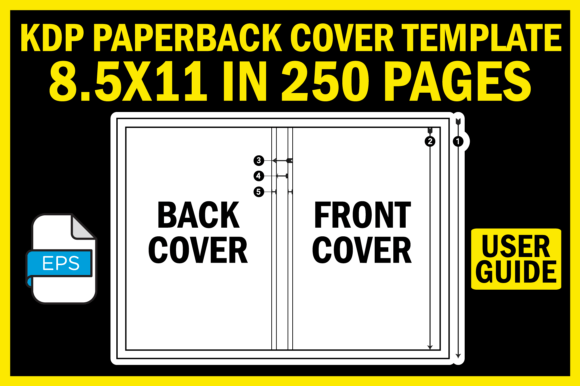
The KDP Cover Template 8.5X11 in 250 Pages eliminates these issues by providing a pre-measured canvas. It accounts for total width (front cover + spine + back cover + bleeds) and total height (trim height + top and bottom bleeds). This means you can focus on your design rather than on calculating margins.
Breaking Down the Template Package Components
A single EPS file alone is not enough—you need supporting documentation to understand how each section of the cover corresponds to the final printed product. This template package includes several assets that work together:
- EPS File (High-Resolution 300 DPI): This is the core working file. It contains vector-based layers that clearly mark trim lines, bleed edges, spine boundaries, and safe zones. The 300 DPI resolution ensures that any raster elements you place will print with crisp detail. The EPS format is compatible with Adobe Illustrator, Affinity Designer, and many other professional vector editors.
- CoverSizeGuide.jpg: A visual reference image that labels every part of the cover. It shows exactly where the front panel ends and the spine begins, how much space is allocated to the back cover, and where the barcode should be positioned. This guide is invaluable for anyone who learns better by seeing rather than reading instructions.
- ReadMe.txt: A plain-text user guide that provides step-by-step instructions. It covers how to open the EPS file, which layers to keep locked, how to place your own images and text without violating safe zones, and how to export the final file for KDP upload.
Together, these files form a complete toolkit. You are not just getting a blank canvas—you are getting a guided system that explains the rationale behind each measurement.
Who Benefits Most from This Template?
This template serves a wide cross-section of users, each with distinct needs. Here is how different groups can leverage it effectively:
Self-Publishing Authors and Indie Writers
If you have written a nonfiction book, a textbook, a poetry collection, or a children's book at the 8.5 x 11 inch trim size, your cover design skills may not match your writing ability. Rather than hiring an expensive designer or struggling with trial and error, you can open the template and drop your artwork into the correct zones. The spine width is already calculated for 250 pages, so you will not have to redo your layout if you later adjust the interior file. The template gives you the confidence to produce a professional-grade cover on your own timeline.
Graphic Designers and Cover Artists
For designers who produce covers for clients, efficiency is everything. Having a pre-built template that is guaranteed to meet KDP's 8.5 x 11 inch, 250-page specifications means you can skip the setup phase and move straight to creative work. The EPS file's layer structure allows you to keep the trim and bleed guides visible while you design, and you can lock those layers to prevent accidental shifts. This reduces revision cycles and helps you deliver files that pass KDP validation on the first attempt.
Educators and Course Creators
Teachers assembling workbooks, lab manuals, or handbooks at this trim size often produce covers internally. They need a solution that does not require deep design expertise. The CoverSizeGuide.jpg acts as a quick reference for school staff or volunteers who may only format one book per year. The template ensures that the cover fits the printed interior perfectly, avoiding the embarrassment of a crooked spine on a classroom resource.
Business Owners and Marketing Professionals
Companies that produce branded manuals, portfolios, or promotional booklets in-house benefit from consistent formatting. The KDP Cover Template 8.5X11 in 250 Pages standardizes the output across multiple projects. Once your team understands how to use the EPS file and the supporting guides, you can produce covers that align with your brand guidelines without re-measuring each time.
Hobbyists and Small Press Publishers
Photographers compiling portfolios, genealogists printing family history books, or small press publishers running limited editions all need accuracy without overcomplicating the process. The template package is a one-time download that can be reused across projects of the same trim size and page count. The ReadMe.txt clarifies common pitfalls, such as forgetting to flatten layers before export or using RGB color mode instead of CMYK.
Practical Workflow: From Template to Upload-Ready Cover
Knowing what the template contains is only half the battle. Understanding how to use it in a real production workflow is where the real value lies. Here is a typical sequence that many users follow:
- Open the EPS file in your vector editing software. Ensure that your color mode is set to CMYK and your resolution is at least 300 DPI. The file will already have guides and layers labeled for front, spine, back, bleed, and safe areas.
- Familiarize yourself with the CoverSizeGuide.jpg. Open this image side by side with your design software. Identify the trim line (where the book will be cut), the bleed line (where the background must extend), and the safe zone (where all critical text and imagery must remain).
- Place your background image or color. Extend it to the bleed line on all sides. This ensures that after trimming, no white edges appear. For an 8.5 x 11 inch book, the total canvas size including bleeds will be larger than the trim dimensions—the template already accounts for this.
- Design the front, spine, and back panels. Keep all essential elements—titles, author name, logos, taglines—within the safe zone. The spine should be center-aligned vertically and horizontally. Use the template's spine guides to position text accurately. For a 250-page book, the spine is wide enough to accommodate a readable title, but space is still limited; avoid overly large fonts.
- Place the barcode and ISBN. KDP usually provides a barcode generated from your ISBN. Position it in the designated area on the back cover, as indicated in the template. The barcode must stay inside the safe zone and away from the edge to avoid being trimmed or obscured.
- Review your layers. Lock the template guide layer before exporting so that no measurement lines appear on your final file. Save a working copy. Then export a flattened PDF or TIFF at 300 DPI, using the same dimensions as the original template.
- Upload to KDP. Use the paperback cover uploader. Because your file matches the template dimensions, KDP should accept it without dimension errors. Use the preview tool to check alignment—rotate the 3D preview to verify the spine and back cover positioning.
This workflow applies whether you are designing a minimalist cover with large typography or a full-bleed photographic image. The template adapts to your creative direction while enforcing the structural rules that KDP demands.
Technical Considerations for Optimal Output
Even with a reliable template, some technical details can make or break the final print quality. Here are observations that experienced users have found helpful:
- Resolution consistency: The EPS file is set to 300 DPI. Any raster images you import should also be at least 300 DPI at their placed size. Lower-resolution images will appear pixelated in print, regardless of the template's quality.
- Color space: KDP prints in CMYK. Design in CMYK from the start. Converting from RGB to CMYK after finishing can cause unexpected color shifts, especially in vibrant blues and greens. The template does not enforce a specific color profile, but using U.S. Web Coated (SWOP) v2 is a common safe choice.
- Layer management: The EPS file contains locked guide layers. Do not delete or unlock them until you are ready to export. If you need to modify a guide for a custom adjustment, duplicate the file first. Keeping guides intact ensures you always have a reference.
- Font embedding: Convert all text to outlines (curves) before exporting, or embed the fonts in your final file. KDP does not require outlines, but if you share the file with a printing partner or reopen it years later, outlines prevent font substitution issues.
- File format for upload: KDP accepts PDF and TIFF formats for covers. A PDF saved with the PDF/X-1a standard is widely used because it enforces CMYK and flattens transparency. The template's high-resolution EPS exports cleanly to this standard.
These considerations are not unique to this template—they apply to any KDP cover project. However, having a template that already includes the correct dimensions and guides allows you to focus your attention on these finer points rather than on recalculating the overall layout.
Real-World Use Cases and Observations
Consider an author who spent weeks writing a guide on urban gardening. The interior is formatted at 8.5 x 11 inches and runs 248 pages—close to the 250-page template specification. Using the KDP Cover Template 8.5X11 in 250 Pages, the author places a photograph of a raised garden bed on the front cover, extends the green background across the spine to the back, and adds a testimonial on the back panel. The spine is wide enough to display the title and author name clearly. The entire process, from opening the EPS file to exporting the final PDF, takes under two hours. The author avoids the $50–$150 cost of hiring a designer and retains full creative control.
In another scenario, a small press publisher produces a series of architectural sketchbooks, each exactly 8.5 x 11 inches and exactly 250 pages. The publisher uses the same template for every volume. The front cover changes with each building study, but the spine and back cover layouts remain consistent. The CoverSizeGuide.jpg is printed and taped to the wall of the design studio as a permanent reference. The template becomes a production standard that ensures every book in the series shares the same dimensions and print readiness.
Even experienced designers occasionally underestimate the spine width for a 250-page book printed on cream paper versus white paper. The template eliminates this variable because it is built for a specific page count. Designers can trust the spine measurement, which is not always the case with generic templates that claim to fit a range of page counts. The specificity of this template—8.5 x 11 inches, 250 pages—is its greatest strength.
Beyond the Cover: How This Template Supports the Entire Publishing Workflow
A cover template does not exist in isolation. It interacts with the interior file, the KDP upload interface, and the final print product. When the cover aligns perfectly with the interior trim size, the book looks cohesive. Readers notice when a cover is off-center or when the spine text is shifted. These subtle defects can harm reviews and sales. By starting with an accurate template, you reduce the risk of such errors.
Furthermore, if you plan to create a series of books at the same trim size but with varying page counts, you can use this template as a baseline. For books that differ slightly from 250 pages, you can adjust the spine width proportionally. The template teaches you the relationship between page count, paper weight, and spine thickness—knowledge that you can apply to future projects. The ReadMe.txt often contains notes on how to modify the template for other page counts, making it a learning tool as well as a production asset.
Publishing professionals who handle multiple titles often build a library of templates for common trim sizes and page counts. This template deserves a place in that library because it covers a very common format: the 8.5 x 11 inch paperback is widely used for textbooks, workbooks, manuals, and nonfiction. Having it ready reduces friction every time a new project in this category appears.
Making the Most of the Included Resources
To truly benefit from the template package, treat each file as part of a system:
- The EPS file is your digital canvas. Use layer naming conventions to keep your design organized. Label your artwork layer, your text layer, and your background layer separately.
- The CoverSizeGuide.jpg is your training material. Keep it open on a secondary monitor or print it out. Even after you become comfortable with the template, the guide serves as a quick reminder of safe zone limits and spine proportions.
- The ReadMe.txt is your troubleshooting manual. If you encounter issues exporting the file or if KDP rejects your upload, the ReadMe often contains tips about flattening transparency, checking DPI, or verifying dimensions. Reading it before you start can prevent common mistakes.
Users who invest a few minutes studying these resources before diving into design consistently report a smoother experience. The template is not just a file—it is a complete support package that anticipates the questions and problems that arise during cover creation.
A Final Observation on Workflow Efficiency
The difference between a stressful cover creation process and a streamlined one often comes down to preparation. Measuring and setting up guides from scratch for each book is time-consuming and error-prone. The KDP Cover Template 8.5X11 in 250 Pages eliminates that overhead. Whether you are publishing one book or fifty, the template pays for itself in time saved and mistakes avoided. It allows you to concentrate on the creative and strategic aspects of cover design—choosing imagery, refining typography, and crafting a visual message that resonates with your target readers—while trusting that the technical foundation is sound.
For anyone committed to producing professional-quality paperbacks through KDP, having a reliable template for common trim sizes and page counts is a mark of a prepared publisher. This template meets that need for the 8.5 x 11 inch, 250-page format, and it does so with the precision and supporting documentation that both beginners and experienced users can rely on.