Hard Hexagon Mazes Vol-79: Adult Puzzle Challenge
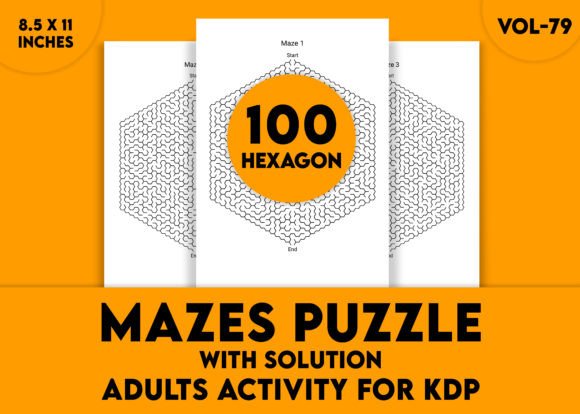
Adults Hard Hexagon Mazes Puzzles Vol-79 offers a focused, screen-free workout for your brain. This collection contains 100 distinct hexagon mazes, each printed on its own 8.5x11-inch page. Unlike simpler puzzles that follow a straight path, these mazes introduce twists, loops, branches, and barriers that demand careful planning and flexible thinking. You get one hexagon maze per page, with four solutions listed at the back of the book, plus an editable PDF if you prefer to work digitally or print extra copies. The format is intentional: large enough to see every detail, yet compact enough to fit in a folder or on a desk without overwhelming you.
Hexagon grids differ from traditional square or circular mazes because they create six possible directions at every intersection. This design choice multiplies the number of decision points and forces your mind to evaluate more options before moving forward. For adults who spend their days managing spreadsheets, designing campaigns, writing content, or running businesses, this kind of spatial reasoning exercise provides a refreshing cognitive shift. It engages the same problem-solving muscles you use in project planning, debugging code, or mapping out a content calendar, but in a low-pressure, analog format.
Let us explore what makes this volume useful, how different creative professionals can adapt it, and practical ways to integrate maze-solving into your routine without treating it as a chore.
What Makes These Hexagon Mazes Different
Standard maze puzzles often rely on dead ends that are easy to spot. The hexagon mazes in Vol-79 are designed to feel less predictable. Because each cell connects to six neighbors, a wrong turn might send you in a direction that seems correct for several steps before revealing itself as a loop or barrier. The obstacles and barriers included in certain puzzles force you to reconsider paths you might have already marked, simulating real-world problem solving where conditions change as you gather more information.
For educators and hobbyists, this structure is ideal for teaching concepts like graph theory, pathfinding algorithms, or even basic geometry in a hands-on way. You can point to a maze and say, “This is a real example of a decision tree with six branches at every node.” The visual immediacy of the hexagon layout makes abstract ideas tangible. If you run workshops or teach adults in a corporate training setting, a single maze page can become the basis for a 15-minute discussion on systematic thinking or risk assessment.
Creative Applications for Different Audiences
The beauty of a puzzle collection like this is that it is not locked into one use case. Depending on your role and goals, you can adapt the same 100 mazes in completely different ways.
For Designers and Creatives
If you work in visual design, the hexagon grid itself is a pattern worth studying. The mazes can serve as inspiration for geometric motifs in branding, packaging, or web backgrounds. You might trace the solution path and use it as a vector line for a logo or a decorative element in a layout. The symmetry and irregularity of the hexagon shapes create organic but structured patterns that feel modern and architectural. Try photocopying a solved maze at low opacity and layering it behind type for a subtle texture effect. Because each maze is unique, you have 100 different starting points for a graphic element that looks handcrafted.
Another angle: use the mazes as a mindfulness tool between creative blocks. Ten minutes of tracing a path with a pen resets your attention and prevents the burnout that comes from staring at a screen. Many designers I know keep a small pad of mazes or dot grids nearby for this exact purpose.
For Marketers and Content Creators
Mazes are inherently shareable. A time-lapse video of solving a particularly tricky hexagon maze can perform well on social media platforms like Instagram or TikTok, especially if you narrate your thought process. Marketers can position Vol-79 as part of a “premium productivity kit” or a “digital detox bundle” for their audience. Bloggers writing about focus, cognitive health, or adult hobbies can embed direct examples from the book by photographing a maze mid-solution and annotating the strategies used.
If you run a newsletter, consider a weekly “Maze of the Week” feature where you share one hexagon puzzle from the editable PDF, challenge your subscribers, and reveal the solution in the next issue. This builds engagement and gives people a reason to open your email beyond the usual promotional offers. The large 8.5x11 size ensures that even a screenshot on a phone is readable, but the full-page print version works well for a desktop or tablet.
For Entrepreneurs and Small Business Owners
Entrepreneurs often need to make decisions with incomplete information, evaluate multiple paths simultaneously, and pivot when a barrier appears. Solving hexagon mazes mirrors these dynamics in a low-stakes environment. You can use the puzzles as a warm-up exercise before a strategic planning session. Give each team member the same maze and see who finishes first, then discuss the different routes they tried. This is not about competition—it is about observing different problem-solving styles.
Some small business owners I know print a maze from the editable PDF and leave it in the break room with a sign that says, “Solve this before lunch and tell me your time.” It becomes a casual conversation starter and a way to connect with employees outside of work tasks. The cost per puzzle is negligible, but the social return can be significant.
For Freelancers and Remote Workers
Freelancers often struggle with boundary setting and mental fatigue. A printed maze on an 8.5x11 sheet is a physical object that signals “I am taking a break.” Because each maze takes anywhere from five to twenty minutes depending on difficulty, it fits neatly into a Pomodoro session. You can solve one maze during the five-minute break between work intervals, and the tactile action of drawing a line helps your brain transition from focused work to rest and back again.
If you work from home, the editable PDF allows you to load the mazes onto a tablet and use a stylus to solve them without printing. This saves paper if you are environmentally conscious, while still preserving the hand-to-eye coordination benefit. The large 8.5x11 size ensures the hexagons are not cramped, even on a standard tablet screen.
How to Keep Your Solving Sessions Productive and Enjoyable
To get the most out of Adults Hard Hexagon Mazes Puzzles Vol-79 without turning it into a frustrating experience, consider a few practical strategies.
Start with a clear goal. Are you solving for relaxation, for speed, or for accuracy? If your goal is relaxation, take a pencil so you can erase wrong turns and avoid the pressure of permanent ink. If you want to challenge your speed, use a pen and commit to each decision. The same maze can feel completely different depending on which approach you take.
Use the solutions sparingly. The book provides four solutions per page, but looking at them too early robs you of the cognitive benefit. Try solving at least half the maze before checking a solution. Treat the solution as a learning tool, not a crutch. When you do check, compare the solution path to your attempted path and note where you made a wrong assumption. This reflective step strengthens your ability to recognize patterns in future mazes.
Rotate your medium. Tackle some mazes on paper with a fine-tip pen, some on a tablet with a stylus, and some by tracing the path with your finger without marking the page. Each method changes how you process the spatial information. Finger tracing, for example, forces you to hold more of the path in working memory, which is an excellent exercise for recall and concentration.
Keep a log. If you are using the mazes as a cognitive training tool, note the date, the maze number, the time to completion, and any strategies you discovered. Over the course of 100 mazes, you will see measurable improvement in how quickly you identify dead ends and loops. This data can be motivating on days when a puzzle feels impossible.
Practical Ideas for Group and Classroom Settings
If you are an educator, trainer, or workshop facilitator, hexagon mazes offer more than individual practice. Here are three realistic ways to use them with a group.
Collaborative solving. Project a maze onto a screen or whiteboard and have the group decide as a team which direction to go at each junction. This exercise builds consensus-building skills and reveals how different people interpret the same visual information. It is especially useful for teams that need to improve communication around ambiguous tasks.
Timed challenges. Give each participant the same maze from the editable PDF and start a timer. After five minutes, stop everyone and discuss the strategies used. This works well as an icebreaker or as a way to illustrate that there is rarely one “correct” approach to a complex problem.
Design your own maze. After solving several hexagon mazes, challenge participants to create their own using the hexagon grid as a base. This flips the cognitive demand: instead of finding a path, you must design a path that is solvable but non-obvious. It is an excellent activity for understanding how constraints and barriers affect problem difficulty.
Why the Large Format Matters
The 8.5x11-inch size is not accidental. Standard letter size means you can print at home without special paper, store the mazes in a binder, and easily see the entire puzzle without scrolling or folding. For adults with visual fatigue or those who prefer larger lettering, the generous spacing reduces eye strain. Each hexagon is big enough to write a small arrow or dot inside without crowding. If you are a publisher or content creator looking to produce similar material, the 8.5x11 format is also the most widely compatible with online print-on-demand services and PDF distribution platforms like Gumroad or Etsy.
From a usability standpoint, one maze per page is ideal. You never have to deal with two puzzles bleeding into each other or accidentally skipping a maze because the pagination is confusing. The four solutions per page at the back are equally spaced and numbered clearly, so there is no friction when you want to verify your answer.
Keeping It Fresh Across 100 Mazes
Solving 100 mazes might sound repetitive, but the hexagon topology ensures variety. Some mazes will have a single winding path with few branches, while others will present a dense web of loops that require backtracking. You can approach them in order or jump around based on your mood. A good practice is to solve the first 20 mazes sequentially to build familiarity, then skip to the last 20 for a spike in difficulty, then return to the middle ones as a warm-up.
If you are using the editable PDF, you can also resize the mazes or change their orientation. Printing a maze rotated 90 degrees forces you to reorient your sense of direction, adding another layer of challenge without altering the structure. Small modifications like this extend the life of the 100 puzzles far beyond a single pass.
Final thought: Adults Hard Hexagon Mazes Puzzles Vol-79 is a tool for anyone who wants to practice decision-making in a safe, repeatable environment. Whether you are a designer looking for pattern inspiration, a teacher illustrating logical reasoning, or a freelancer needing a screen break, the hexagon shape and large format make these puzzles accessible and genuinely challenging. The value is not in finishing all 100, but in how you choose to engage with each one.