Adults Hard Hexagon Mazes Puzzles Vol-53: A Practical Guide to Getting the Most Out of Every Puzzle
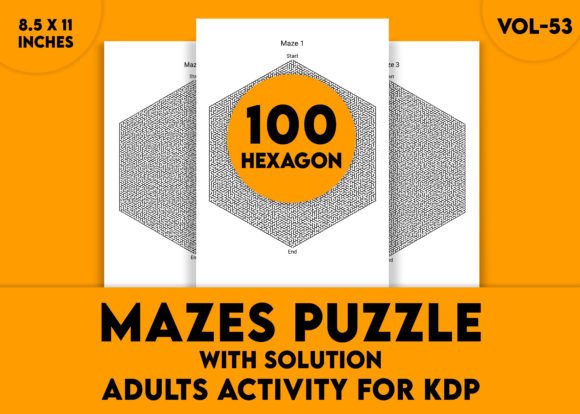
If you have picked up Adults Hard Hexagon Mazes Puzzles Vol-53, you already know these are not your average afternoon diversions. Each of the 100 mazes is built around a hexagon grid, printed one per page on standard 8.5x11-inch paper, with four solutions provided per page at the back. The puzzles are deliberately complex, with multiple branches, loops, dead ends, and occasional barriers that demand real spatial reasoning. Whether you are a creative professional looking for a mental reset, a freelancer who needs a structured break, or simply someone who enjoys a good challenge, this volume offers serious puzzle work. But even with a well-designed product, a few common missteps can turn a rewarding experience into a frustrating one. Here is what to watch for, how to avoid those pitfalls, and how to make every maze count.
Understanding What You Are Working With
Before diving into strategy, it helps to know exactly what makes these mazes different. Standard rectangular mazes rely on orthogonal turns and familiar grid logic. Hexagon mazes introduce six possible directions at each cell, which means more branching points and less intuitive pathfinding. The puzzles in Adults Hard Hexagon Mazes Puzzles Vol-53 are designed to push your ability to track multiple possibilities simultaneously. If you approach them with the same tactics you use for simpler puzzles, you will quickly find yourself stuck or backtracking more than necessary.
Mistake One: Jumping In Without a Pencil Strategy
The most common error people make is starting a maze with no plan for how they will mark their progress. Many adults grab whatever pen is nearest and begin tracing a path. Within a few minutes, the ink lines become a mess of scratched-out routes, and you can no longer tell which branches you have already explored.
Why this hurts your experience: Without a clear marking system, you waste time retracing dead ends repeatedly. You also risk losing confidence when the page becomes visually cluttered. The satisfaction of solving a hard maze comes partly from seeing a clean, logical path emerge. A chaotic page works against that.
Better approach: Use a pencil with a soft lead, preferably one you can erase cleanly. Begin by lightly tracing your route as you explore. When you hit a dead end, mark it with a small dot or a light X so you know not to go that way again. If you prefer a more permanent record, keep a separate sheet of tracing paper over the maze and draw your attempts there. This keeps the original page pristine and lets you reuse the puzzle if you want to try again later. Many people who work through Adults Hard Hexagon Mazes Puzzles Vol-53 find that a light touch with a mechanical pencil gives them the control they need for the fine hexagon cells.
Mistake Two: Misusing the Solution Pages
The volume includes four solutions per page, which means each solution is compact and sometimes condensed. A frequent misunderstanding is that you can glance at the solution page and instantly see the correct path without studying it carefully. In reality, because the solutions are grouped together, the printing is small, and the hexagon grid can make the solution lines look similar to the maze lines themselves.
Why this causes problems: If you rely on the solutions as a crutch early on, you never develop the spatial reasoning skills these puzzles are meant to build. If you flip to the solution too late, after already committing to a wrong branch, you may waste even more time trying to reconcile what you see with what you have drawn.
Better approach: Treat the solution pages as a final check, not a guide. Try to solve each maze completely on your own first. If you are genuinely stuck after several attempts, use the solution to understand the logic of the correct path rather than just copying it. Look at where the solution turns and note why your own route went wrong. This turns a moment of frustration into a learning opportunity. If you are using the PDF version, you can even hide the solution pages until you are ready by keeping them in a separate folder or using the page navigation to skip past them.
Mistake Three: Ignoring the Editable PDF Feature
One of the most underused features of Adults Hard Hexagon Mazes Puzzles Vol-53 is that it comes as an editable PDF file. Many people print the entire book at once and never realize they could solve puzzles directly on a tablet or computer. This is a missed opportunity, especially for those who travel, work in digital environments, or prefer to keep their workspace paper-free.
Why it matters: Solving on screen allows you to use layers, undo mistakes instantly, and zoom in on tight sections of the hexagon grid. You can also save your progress and come back to a partially solved maze later without worrying about losing your place. For professionals and entrepreneurs who already spend much of their day on a device, this can make the puzzle experience seamless rather than a separate paper-based task.
Better approach: Open the PDF in a program that supports drawing or markup, such as a PDF editor or a note-taking app. Use a stylus if you have one, or even your finger on a tablet. The hexagon cells are large enough to work with on screen, and you can erase or adjust your path without leaving marks. If you prefer paper but want the flexibility, print only the pages you are working on, not the entire volume at once. This way, you can adjust your printing quality and paper type based on your current environment.
Mistake Four: Overlooking Print Settings and Paper Size
The mazes are designed for 8.5x11-inch paper, but not every printer handles that size the same way. Some people print at a reduced scale to save paper, or they use a different paper size and let the printer scale automatically. This can shrink the hexagon cells to a point where they become difficult to trace, especially around the loops and barriers.
How this affects your results: When the grid is too small, your lines may cross into adjacent cells accidentally, leading to confusion about which path you are following. You might also miss subtle twists in the maze design because the details are compressed. The puzzles in this volume are carefully laid out to fill the page, so scaling them down removes some of the intentional spacing that makes them solvable with a clear head.
Better approach: Always print at 100% scale on 8.5x11-inch paper. Check your printer settings before hitting print. If you are using a printer that defaults to "fit to page," change it to "actual size" or "no scaling." If you prefer a larger working area, you can print at 110% or 120% onto legal-sized paper, but be aware that the margins may shift. The important thing is that the hexagon cells remain crisp and at their intended size. This small check before printing saves you from squinting through 100 mazes.
Mistake Five: Rushing Through Without a Method
Hard hexagon mazes reward patience, but many adults approach them with the same speed they use for casual puzzles. They start at the entrance and immediately charge forward, hoping intuition will carry them through. With multiple branches and loops, that approach almost always fails midway.
Why it leads to frustration: You end up deep in a branch that loops back on itself, and you cannot remember which turns you already took. The cognitive load increases, and what should be a relaxing challenge becomes a source of stress. You may even abandon a maze halfway through, feeling like you are not good at puzzles, when the real issue is simply your method.
Better approach: Before you put pencil to paper, spend 30 seconds studying the maze. Look for obvious long corridors, clusters of dead ends near the edges, and sections where the loops seem concentrated. Many of the puzzles in Adults Hard Hexagon Mazes Puzzles Vol-53 have a recognizable structure once you step back. Work from both ends simultaneously if you can: trace forward from the start and backward from the goal. This halves the search space and often reveals a path faster than a one-directional approach. If you hit a complex loop, stop and mentally map it before proceeding. A few seconds of planning can save ten minutes of backtracking.
Mistake Six: Forgetting to Check Your Workspace Setup
This one sounds trivial, but it affects more people than you might expect. Hexagon mazes require fine motor control, especially around tight turns and barriers. If you are working at a cluttered desk with poor lighting or on a soft surface like a bed or couch, your hand control suffers. Lines wobble, you accidentally cross into neighboring cells, and you have to constantly reorient the page.
Why it reduces quality and satisfaction: You might blame the puzzle or yourself, but the real culprit is your environment. A hard maze demands a stable surface and good light. If you are squinting or fighting against a slippery page, your cognitive energy is split between solving and managing physical discomfort.
Better approach: Use a clipboard or a hardback book as a writing surface if you are not at a desk. Position a lamp so it shines directly on the page, reducing shadows in the hexagon cells. If you prefer working on a tablet with the PDF, adjust the brightness and consider a matte screen protector to reduce glare. These small adjustments make a noticeable difference, especially as you work through the harder puzzles later in the volume.
Making the Most of Each Puzzle
Beyond avoiding mistakes, there are a few habits that can elevate your experience with Adults Hard Hexagon Mazes Puzzles Vol-53. Consider setting a timer for each maze, not to pressure yourself, but to track how your speed improves over time. You might also keep a small journal where you note which strategies worked for specific maze shapes. Over the course of 100 puzzles, you will develop a personal toolkit of techniques that apply to hexagon grids specifically.
Another idea is to rotate the page as you work. Because hexagon grids have a natural orientation, a twist of 60 or 120 degrees can reveal a pattern you missed. This works especially well for puzzles with barriers or blocked cells that look different from one angle. Do not be afraid to physically turn the paper or rotate your tablet to get a fresh perspective.
Finally, remember that the goal is not just to finish every maze as fast as possible. The real value lies in the mental workout itself. Each puzzle strengthens your ability to hold multiple possibilities in mind, test hypotheses, and recover from wrong turns without frustration. These skills transfer directly to problem-solving in work and daily life, whether you are debugging code, planning a project timeline, or navigating a complex negotiation.
What to Check Before You Begin
Before you open the first maze, take a moment to verify a few things. Make sure you have a pencil or stylus ready. Confirm that your print settings are correct if you are using paper. If you plan to solve digitally, open the editable PDF in a program that supports drawing and check that the file loads smoothly. Flip through the solution pages to understand their layout so you can find the right answer later without fumbling. And set up a comfortable workspace with good lighting and a stable surface.
These checks may seem minor, but they are the difference between a session that flows and one that stumbles. Adults Hard Hexagon Mazes Puzzles Vol-53 offers 100 opportunities to challenge yourself in a structured, satisfying way. With the right approach, each maze becomes a small victory worth enjoying. Take your time, stay methodical, and let the hexagons guide you.